Temperature reading offers a chance to check on “where we are” in this present moment. Useful when you’d like to discover a focus topic on the moment. It also allows to include aspects of group life usually ignored: appreciations, puzzles, hopes and wishes.
This activity can also be used for closing the retro, to get a topic for the next one
Duration: 10-30 minutes
Steps
- Introduce the activity “Let’s look at what’s happening in our group. You can contribute in any of the sections, but participation is voluntary. The aim is to hear from others, so no one may comment on another’s contribution. While we need to hear your responses, the biggest opportunity is to hear what others have to say.”
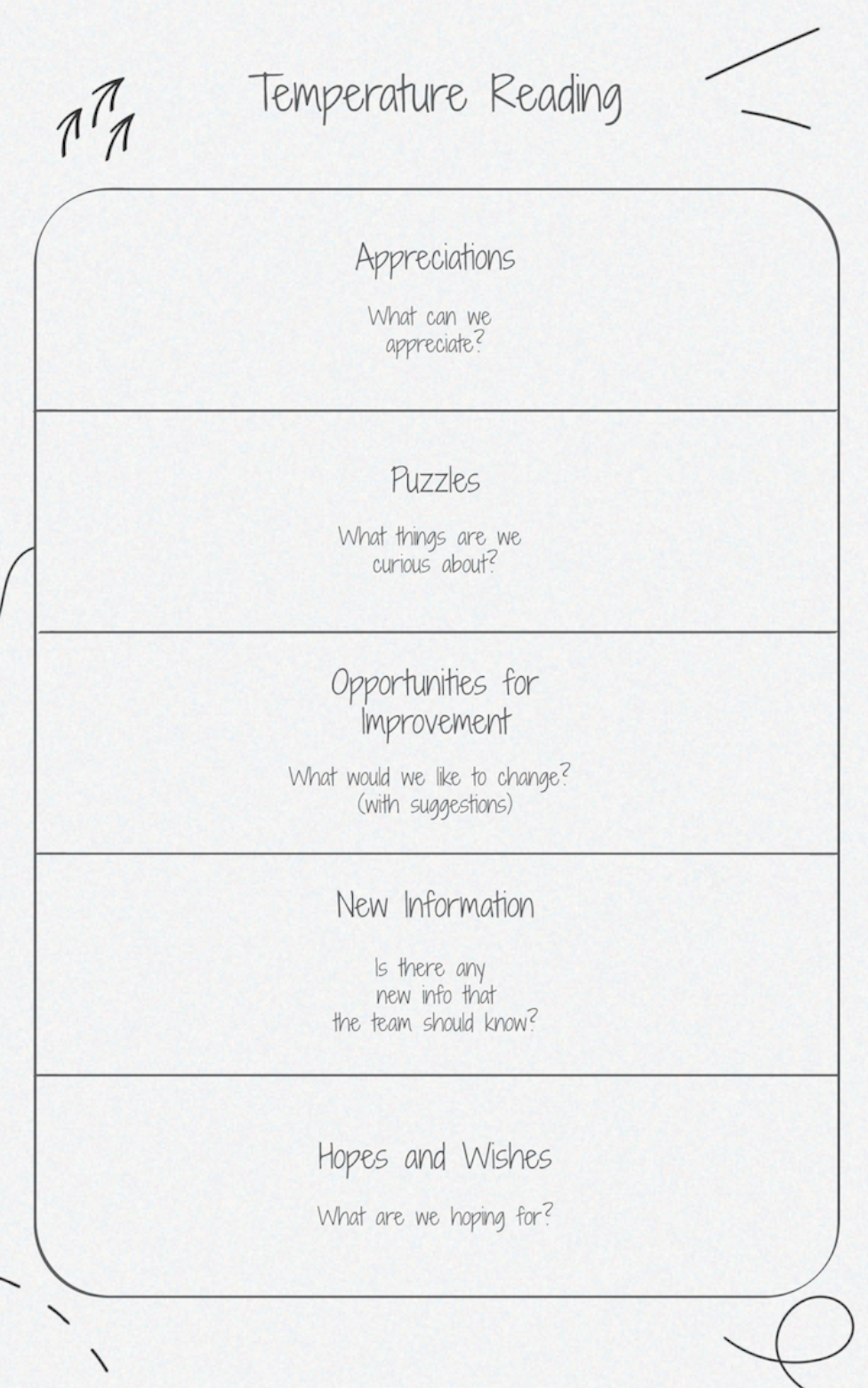
- Point to the “Elements of Temperature Reading” poster. Comment on each of the 5 sections and allow time for people to contribute
- Wait between each section. Record puzzles and opportunities on a visible, shared document
Sections:
- Appreciations: opportunity to see how others have contributed and what they bring to the team “(Name), I appreciate you for …”
- Puzzles: things we don’t understand, but are curious about
- Opportunities for improvement: allow people to point out what they’d like to be different and options for improving them
- New Information: useful to share information that may be relevant to the group but that is not widely shared or known
- Hopes and Wishes: let us say what we hope either for the retro or going forward after
Notes from the authors
We’ve learned a trick for leading the Temperature Reading activity. Learn to count silently to yourself. This format is unfamiliar to most people. It can take them a while to become comfortable with it. Silent counting gives the facilitator something to do while waiting and ensures that people have time to gather their thoughts. After demonstrating how to give an appreciation, start counting slowly to yourself. Look around the group with an inviting expression as you count. Stay with appreciations until you’ve counted to 75. Well before then, someone will step forward. Stop counting when someone speaks up. One person giving an appreciation usually gets the group going. When the number of appreciations offered slows down, count to 20 after the last one. If no one speaks up, then move on to Step 2b, New Information. Describe the next element, and start counting to 20. Afterward, use a count of 20 to help wait through each pause. Once a team has become used to Temperature Readings, they jump right in. You won’t get to count.”