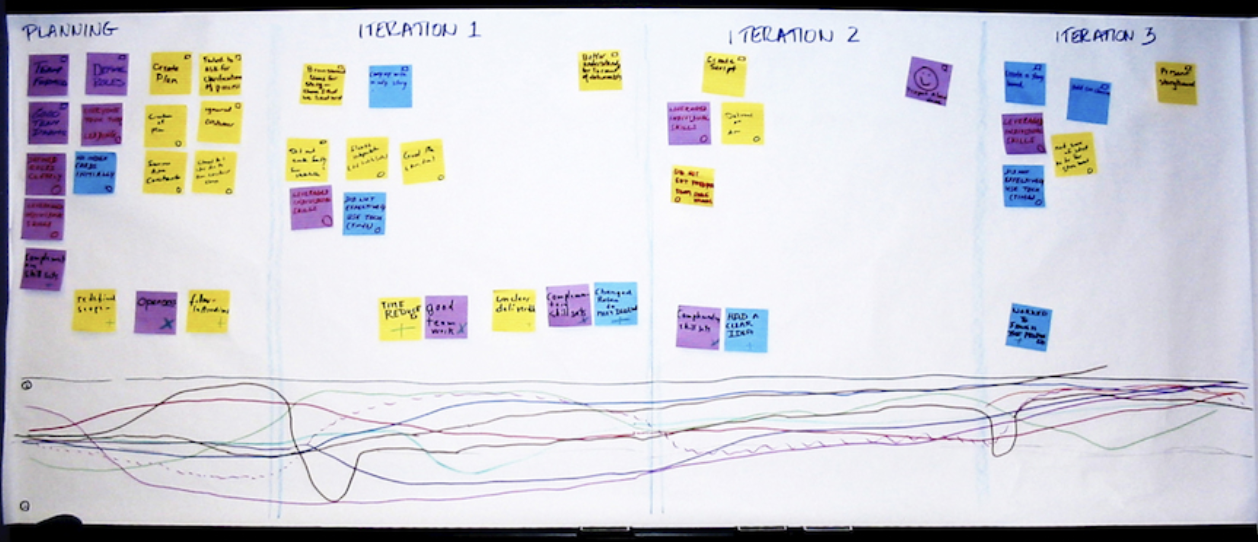
Use a Timeline to gather data about what’s happened over a period of time and how people perceive those events. Team members may perceive the same events in different ways (biases, recency, role etc.. change the percepton).
Duration: 20-90 minutes, depending on the size of the group and of the timeline
Steps
- Set-up the activity: “We’ll fill the timeline to create a fuller picture of the work we did during (period). We want to see it from many perspectives”
- If the team has more than 5 members, divide in pairs or small groups
- Hand our markers and index cards or sticky notes
- Describe the process. Ask people to think back on all the memorable, personally meaningful, or significant events of the work interval. Ask them to write those down, one per card or virtual sticky notes. Remind the group that the point is to see many perspectives—so they don’t arrive at a consensus about which events go on the timeline.
- Time box the writing down activity. If you’re color coding, explain what the colors mean and post a legend.
- Monitor the level of activity as people start talking about events and writing cards. If people haven’t started writing cards after five minutes, remind them to start writing.
- When the groups have a stack of cards, invite people to start posting them.
- When all the cards are posted, invite the team to walk by the timeline and see what others have posted. It’s OK for people to add new cards as they remember more events.
Variation: Color-Coded dots
A variation to generate more subjective data on the timeline. Ask the team to make one more pass on the timeline and indicate another aspect of their experience.
Example: give dots of 2 different colors. Use one color for high points and another for low points. Ask them to distribute points across the timeline.
E.g. proud/sorry, energized/drained, high/low impact
To debrief, look for items with the most dots or any other pattern, and invite the team to discuss the patterns they see.